ZRG Strikes Gold
•
Telenor Microfinance Bank awards ZRG OneView Contact Center System
•
ZRG Receives 5th Consecutive Achievement Gold Award from FPCCI
•
Al Baraka Bank Chooses ZRG OneView CMS Software
•
PSO Awards Contact Center Tender To ZRG
•
ZRG Strikes Gold
•
Telenor Microfinance Bank awards ZRG OneView Contact Center System
•
ZRG Receives 5th Consecutive Achievement Gold Award from FPCCI
•
Al Baraka Bank Chooses ZRG OneView CMS Software
•
PSO Awards Contact Center Tender To ZRG
•
ZRG Strikes Gold
•
Telenor Microfinance Bank awards ZRG OneView Contact Center System
•
ZRG Receives 5th Consecutive Achievement Gold Award from FPCCI
•
Al Baraka Bank Chooses ZRG OneView CMS Software
•
PSO Awards Contact Center Tender To ZRG
•
ZRG Strikes Gold
•
Telenor Microfinance Bank awards ZRG OneView Contact Center System
•
ZRG Receives 5th Consecutive Achievement Gold Award from FPCCI
•
Al Baraka Bank Chooses ZRG OneView CMS Software
•
PSO Awards Contact Center Tender To ZRG
•
The same calm waters of Lago Maggiore continue north beyond Italy’s border, framed by steep mountain slopes covered in chestnut forests and the scent of alpine pine in the air. Colorful villas dot the shoreline, and although you have crossed into Switzerland, you have not left Italy behind.
Welcome to Ticino, the Italian-speaking region of Switzerland, where il dolce far niente, the sweetness of doing nothing, meets Swiss precision. This is the setting for Episode 2 of my Lago Maggiore podcast series, a journey into the Swiss side of the lake where culture, language, and landscape blend into something beautifully unique.
In the first episode, we explored the Italian heart of Lago Maggiore, including Stresa, Baveno, and the Borromean Islands, where art and elegance defined the experience. This time, we move north to discover how Italian warmth meets Swiss sophistication. The espresso is strong, the streets are spotless, and the trains arrive with perfect precision.
A Day in Locarno
Locarno rests at the northernmost curve of Lago Maggiore, where the mountains dip their toes into the water. The town enjoys the warmest climate in Switzerland, blessed with a mild microclimate that allows palm trees to grow beside Alpine peaks. It is a place of light, faith, and film.
I still remember my first visit to Locarno with my husband on a warm May afternoon. We had driven up from Italy and arrived in the main piazza, where café umbrellas opened wide to the sun and locals lingered over espresso as the scent of blooming wisteria filled the air. We found a quiet table for lunch, then wandered through the cobbled streets in search of the famous Läderach chocolates, smooth, rich, and utterly irresistible.
We carried them back to the piazza and watched life unfold around us while musicians played softly nearby and the bells of the Church of San Antonio rang in the distance. Later, we took the funicular up to the Sanctuary of Santa Maria del Sasso. Every turn of the climb revealed another breathtaking view of the lake shimmering far below. From ther,e we hiked down through green slopes filled with birdsong and the faint scent of pine.
That evening we continued to Ascona, elegant and colorful, before catching the ferry back across the water. It was one of those perfect travel days when time seemed to stand still, the kind you replay again and again in memory.
Locarno: Sunshine, Cinema, and Sacred Hills
Locarno’s nickname, La Città del Sole, meaning the City of Sunshine, is well deserved. With more than 2,300 hours of sunshine each year, it is one of the brightest places in Switzerland. The light seems to soak into everything, illuminating the ochre façades, the reflections of the lake, and the easy rhythm of life in its piazzas.
At the heart of town lies Piazza Grande, one of the most beautiful squares in Switzerland. Framed by arcaded façades and pastel houses, it is the natural gathering place for both locals and visitors. Cafés spill onto the cobblestones, and by afternoon the air fills with the scent of roasted chestnuts and espresso.
Each August the square transforms into an open-air cinema during the Locarno Film Festival, one of Europe’s oldest and most prestigious film events. A giant screen rises against the historic backdrop while more than 8,000 spectators settle in under the stars. It is an evening of cinematic magic where the glow of the screen competes with the shimmer of the lake nearby. The festival has welcomed icons such as Ingrid Bergman, Sophia Loren, and Jean-Luc Godard, yet it maintains a relaxed and artistic intimacy that perfectly suits Lago Maggiore’s character.
The Sanctuary Above the Lake
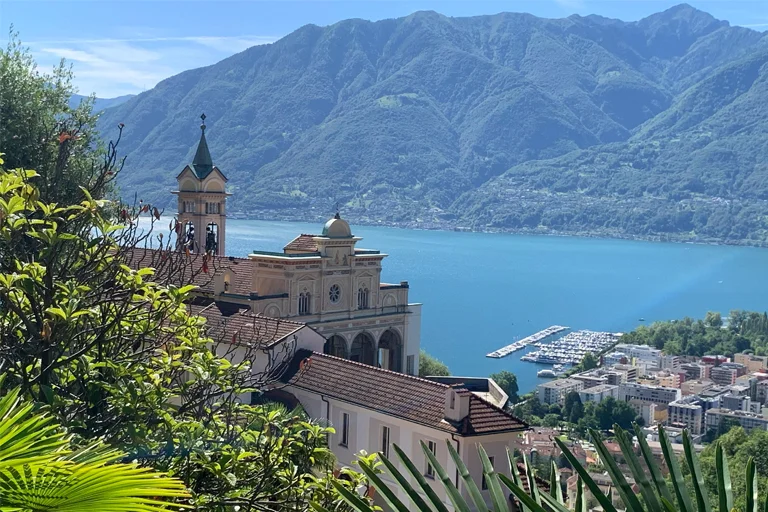
High above Locarno stands the Santuario della Madonna del Sasso, perched on a rocky outcrop overlooking the lake. According to tradition, in 1480, a Franciscan friar named Bartolomeo d’Ivrea experienced a vision of the Virgin Mary here. In gratitude, he built a small chapel that later grew into the grand sanctuary that still welcomes pilgrims today.
Its ochre and white façade glows in the sunlight, framed by terraced gardens and olive trees. Inside, frescoes depict scenes of devotion, while outside, the terrace opens to a panoramic view that stretches across Lago Maggiore and into the mountains beyond.
From the sanctuary, a scenic footpath winds down to Locarno’s old town. The walk takes about twenty minutes through lush vegetation with glimpses of the water between the trees. It is a perfect way to experience the harmony of faith, nature, and beauty that defines Ticino.
Life on the Lakefront
Back at the water’s edge, Locarno continues to delight. The lakeside promenade is lined with palm trees, cafés, and elegant nineteenth-century villas surrounded by gardens filled with camellias and azaleas. It is a lovely spot for a walk or a stop at Bar Pardo for gelato while ferries glide across the lake.
For art lovers, the Pinacoteca Casa Rusca exhibits local and international works inside an eighteenth-century palazzo. For pure relaxation, the Lido Locarno offers thermal pools and lake swimming with views of snow-capped peaks, a surreal combination of summer warmth and Alpine cool.
Flavors of Locarno
Ticino’s cuisine combines rustic Alpine comfort with Italian flair. In Locarno, the must-try dish is polenta e brasato, slow-cooked beef in a rich red-wine sauce served over creamy polenta. Pair it with a glass of Ticino Merlot, the region’s signature wine.
For dessert, order a slice of torta di pane, a sweet bread pudding made with chocolate, raisins, and almonds. Enjoy dinner on a lakeside terrace as the lights shimmer across the water. The experience captures everything that makes Ticino special, a calm sophistication and a seamless blend of Swiss organization and Italian soul.
As night falls, look across the bay and you will see the lights of Ascona twinkling on the horizon. Smaller, artistic, and irresistibly beautiful, it is our next stop in this journey along the Swiss shores of Lago Maggiore.
Ascona: The Riviera of Artists and Dreamers
Just ten minutes from Locarno, along the curve of Lago Maggiore, lies Ascona. It is a place so enchanting that it seems painted rather than built. With its kaleidoscope of pastel façades reflected in the water, elegant cafés along the promenade, and mountains rising behind like a grand stage, Ascona is often called the pearl of Lake Maggiore. Yet this small town offers much more than beauty. It tells a story of art, freedom, and the search for a simpler, more meaningful life.
A Haven for Artists and Free Spirits
At the beginning of the twentieth century, Ascona became a magnet for artists, writers, philosophers, and dreamers from across Europe. They came searching for a different kind of paradise, one centered on creativity and authenticity, far removed from the constraints of city life.
In 1900, a small group of visionaries founded Monte Verità, meaning Mountain of Truth, just above Ascona. It began as a utopian community where people lived in harmony with nature, practicing vegetarianism, meditation, and artistic expression. Writers such as Hermann Hesse, Rainer Maria Rilke, and Carl Jung all visited or were influenced by its ideals.
The residents of Monte Verità believed in simplicity. They walked barefoot through meadows, wore loose linen garments, and spent their days dancing, writing, or painting under the open sky. The community was radical for its time, but its influence endured. Although the original experiment eventually faded, its spirit shaped Ascona into a town that still feels open-minded, artistic, and quietly unconventional.
Today, Monte Verità is home to a museum, gardens, and a tranquil hotel surrounded by chestnut trees and walking paths. Standing there, you can almost feel the echo of those early visionaries who came searching for truth, beauty, and balance long before those ideas became fashionable.
Life Along the Lakefront
Down by the water, Ascona hums with quiet sophistication. The Lungolago, its famous waterfront promenade, curves gently along the harbor. Colorful seventeenth- and eighteenth-century houses painted in shades of terracotta, rose, lemon, and sea blue reflect beautifully in the lake.
Cafés line the promenade with tables filled in the morning with cappuccinos and in the evening with Aperol spritzes. It is impossible not to slow your pace here. Even the locals move with a calm rhythm that seems to match the gentle sound of the water.
The lake mirrors the sky, boats glide across the surface, and the bells of the Church of Saints Peter and Paul ring softly in the distance. The church’s tall slender bell tower rises above the rooftops and serves as a familiar guide as you explore the old town. Inside, fifteenth-century frescoes depict scenes from the Bible with a tenderness that matches Ascona’s gentle soul.
Wandering through the narrow lanes behind the waterfront, you will find art galleries, boutiques, and artisan studios filled with ceramics, jewelry, and paintings. Every corner reveals something beautiful, whether it is a balcony covered with flowers, a quiet courtyard, or a glimpse of the lake framed by climbing bougainvillea.
Culture and Festivals
For such a small town, Ascona has an exceptional cultural life. Every June, it hosts the Ascona Jazz Festival, one of Europe’s oldest open-air jazz events. Picture an evening beside the lake, the notes of a saxophone floating across the water while candlelight flickers on café tables. The atmosphere feels joyful and spontaneous, a celebration of pure music.
Later in the year, Ascona holds the Settimane Musicali di Ascona, a classical music festival that fills the town’s churches and historic venues with elegant performances. The contrast between summer’s outdoor jazz and autumn’s candlelit concerts reflects the balance that defines Ascona’s character.
In spring, smaller community festivals take place throughout town. Flower celebrations, local markets, and artisan fairs bring together residents and visitors in a shared appreciation for creativity, craftsmanship, and beauty.
Taste of Ticino: Dining in Ascona
Ascona’s cuisine reflects its location between the Alps and the Mediterranean. In the old town, rustic grotto-style restaurants serve dishes such as risotto al Merlot, prepared with the region’s ruby-red wine, or creamy polenta with mountain cheese and wild mushrooms.
Along the promenade, elegant restaurants offer fresh lake fish, handmade pasta, and desserts flavored with chestnuts or honey from nearby valleys. For an unforgettable evening, Ristorante Al Pontile serves refined Mediterranean dishes almost directly over the water, while Grotto Baldoria in the historic center offers traditional Ticino comfort food in a cozy and lively setting.
Finish your meal with a small glass of grappa or nocino, a sweet walnut liqueur that has been produced in Ticino for generations. It is the perfect way to toast the warmth of Swiss Italian hospitality.
Nature and Leisure Between Lake and Hills
Beyond the town, Ascona is surrounded by natural beauty. To the west lies the Maggia Valley, a landscape of rivers, waterfalls, and ancient stone villages where life moves at a slower rhythm. It is a paradise for hikers, photographers, and anyone who loves swimming in clear mountain pools during the summer months.
Closer to town, ferries depart for the Brissago Islands, two small oases floating on Lago Maggiore. They are famous for their lush botanical gardens where tropical plants from around the world thrive in the lake’s mild climate. Palm trees, camellias, orchids, and bamboo grow here in abundance, creating an exotic paradise only fifteen minutes by boat from Ascona’s harbor.
For those seeking simple relaxation, Ascona’s small beaches and lakefront lidos are perfect for swimming, sunbathing, or enjoying a quiet afternoon in the shade of a willow tree while watching the ferries glide by.
Reflections on Ascona’s Spirit
There is something about Ascona that lingers long after you leave. It is not only the scenery but the feeling of being drawn into a slower, more reflective rhythm of life. Perhaps it is the legacy of Monte Verità or the soft golden light that settles over the town each evening, turning the water to silver.
Ascona invites you to listen. You can hear the murmur of conversation from the cafés, the sound of oars in the distance, and the faint melody of a jazz saxophone drifting across the bay. It feels like a gentle symphony of serenity carried by the lake.
The beauty of Ascona lies in its harmony. Art and nature coexist gracefully, and every visitor becomes part of the same calm rhythm that has inspired poets, painters, and dreamers for more than a century.
The Brissago Islands: Gardens of the Lake
If Ascona is a painting, then the Brissago Islands are its brushstrokes of green. These two small oases float on the blue surface of Lago Maggiore just fifteen minutes by ferry from Ascona’s harbor. They are small and easy to overlook from a distance, yet up close they reveal a world of extraordinary beauty.
Palm trees sway beside camellias and bamboo groves, while orchids bloom beneath the shade of cypress trees. It feels as though pieces of every continent have been gathered and planted here, surrounded by the calm of the lake and the mountains beyond.
A Botanical Dream
The story of the islands begins in the 1880s when Baron and Baroness Richard and Antoinette St. Leger purchased them as a private retreat. Antoinette, a botanist and writer, transformed the once barren rocks into a living laboratory filled with rare plants from every corner of the world. She cultivated eucalyptus from Australia, bamboo from Asia, and cacti from the Americas, creating her own Eden where science and poetry met in harmony.
After financial difficulties forced her to sell the islands, they passed to Max Emden, a wealthy German merchant and art collector. He built the neoclassical villa that still stands at the heart of the larger island and filled it with art and conversation. In his time, the islands became a meeting place for writers, scientists, and thinkers who found inspiration in this serene landscape.
In 1950, the Canton of Ticino and the Swiss government took ownership of the islands, preserving them as a botanical park open to the public. Thanks to this decision, the legacy of the baroness and the collector continues to thrive, and visitors can now explore one of Switzerland’s most enchanting gardens.
Isola Grande: A Garden of the World
The larger island, Isola Grande, welcomes visitors with lush paths that twist through a remarkable range of plant life. The unique microclimate created by the lake’s mild temperatures allows tropical and subtropical species to flourish. As you walk along the stone paths, you pass through more than seventeen hundred plant varieties from five continents.
There are groves of magnolias and camellias from Asia, papyrus from Egypt, agaves from Mexico, eucalyptus from Australia, and even a bamboo forest that rustles gently in the breeze. Each section of the garden has its own character, shifting from vibrant floral color to deep green shade in just a few steps.
Benches placed along the trails invite you to pause and listen to the soft hum of insects and birds, to breathe in the scent of jasmine, and to watch the sunlight shimmering through the leaves. In this quiet moment, surrounded by both nature and artistry, you begin to understand what makes the Brissago Islands so unforgettable.
At the heart of Isola Grande stands Villa Emden, the elegant mansion built by Max Emden in the early twentieth century. Its pale façade, framed by palm trees and flowers, opens onto a terrace with sweeping views of the lake. Inside, a small museum tells the story of the island’s history through photographs, letters, and botanical sketches that reveal how much passion and perseverance went into cultivating this paradise.
Visitors can also stop at the Café San Léger, named for the original baroness, for a cappuccino or a glass of Ticino Merlot on the terrace. The rhythm of the island encourages stillness, and it is easy to lose track of time as ferries glide quietly across the water below.
Isolino di Sant’Apollinare: The Little Sanctuary
The smaller island, known as Isolino di Sant’Apollinare, is closed to the public and protected as a natural reserve. It serves as a sanctuary for nesting birds, herons, and small animals that find refuge among its dense trees. Seen from the water, it feels wild and untouched, a gentle reminder that Lago Maggiore remains a living ecosystem.
Together, the two islands represent a beautiful balance. One celebrates human creativity and the cultivation of beauty, while the other honors the quiet resilience of nature. This harmony between people and the landscape captures the essence of Ticino itself.
Planning Your Visit
Ferries to the Brissago Islands operate regularly from April through October, departing from Ascona, Brissago, and Locarno. The journey across the water is short, and the view alone is worth the trip. The best time to visit is in spring or early summer when the flowers are at their most vibrant and the air carries the scent of blooming jasmine and magnolia.
Wear comfortable shoes and give yourself plenty of time to wander the paths at your own pace. Photography is welcome, but the real magic lies in slowing down long enough to notice the smallest details: the way the light shifts through the leaves, the hum of bees, or the reflection of the sky in the water.
Before you return to the mainland, take one last look from the ferry deck. The islands appear as tiny emerald drops resting on a silver lake, surrounded by mountains that seem to rise directly from the water. It is one of those images that stays with you long after you have left.
Reflections on Ticino’s Spirit
There is something deeply spiritual about the northern shores of Lago Maggiore. Here, nature and culture do not compete but complement one another. Locarno offers sunshine and devotion. Ascona brings art and imagination. The Brissago Islands embody the harmony between human creativity and natural grace.
Together, they form a landscape that invites travelers to slow their steps, listen to the rhythm of the water, and appreciate the beauty of simplicity. The light of Ticino glows softly, not with grandeur but with peace. It is a light that touches everything it falls upon, from the painted façades of Ascona to the mirrored surface of the lake.
Visiting this region feels like entering a place where time moves differently, where the modern world fades, and what remains is balance, color, and serenity. It is Switzerland speaking Italian, yet speaking to the heart in a universal language of beauty.
Join the Journey
To see more from this region and beyond, follow me on Instagram @immersiontravelitaly, where I share travel moments, behind-the-scenes photos, and festival stories from across Italy.
Sign up for my free Immersion Travelers Newsletter at katerinaferrara.com for insider travel tips, cultural insights, and updates about upcoming guides, podcasts, and events.
You can also watch the YouTube episode for this Lago Maggiore series on the Immersion Travel Italy channel. The video companion brings you directly into the world of Locarno, Ascona, and the Brissago Islands with breathtaking visuals and immersive storytelling.
Experience the calm waters, the rhythm of Swiss Italian life, and the spirit of Ticino that continues to inspire travelers from around the world.