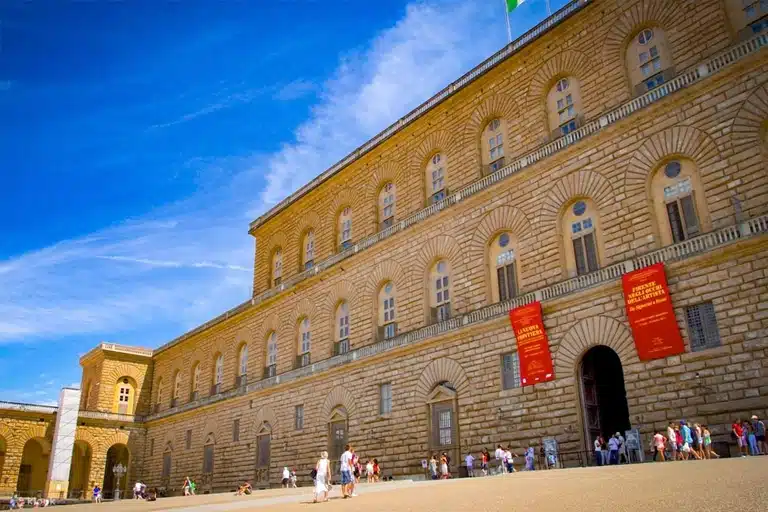
Royal Palaces in Italy Series
Perched atop the highest of Rome’s seven hills, the Quirinal Palace (Palazzo del Quirinale) stands as a testament to Italy’s rich historical tapestry. This magnificent structure, which has witnessed the transition from papal power to royal authority and finally to republican democracy, remains one of the world’s largest palaces and serves as the official residence of the Italian President.
A Monumental Presence in Rome
Spanning an impressive 110,500 square meters, the Quirinal Palace is the sixth-largest palace in the world by area. The complex houses 1,200 rooms spread across multiple floors, making it larger than both Buckingham Palace in London and Versailles in Paris. Its prominent location on the Quirinal Hill, at an elevation of 61 meters above sea level, offers commanding views over the Eternal City.
From Papal Summer Retreat to Presidential Palace
The Papal Era (16th-19th Centuries)
The palace’s story begins in 1583 when Pope Gregory XIII commissioned architect Ottaviano Mascherino to build a summer residence away from the Vatican, seeking refuge from the malarial air that often plagued the Tiber River area. Over the next two centuries, successive popes expanded and embellished the palace, with notable contributions from architects like Carlo Maderno, Gian Lorenzo Bernini, and Ferdinando Fuga.
The Royal Period (1870-1946)
Following the unification of Italy in 1870, the Quirinal Palace transformed into the official residence of the House of Savoy, Italy’s royal family. King Victor Emmanuel II had the palace extensively renovated to suit royal requirements, adding modern amenities while preserving its historical character. During this period, the palace became the setting for elaborate state functions and royal ceremonies, hosting European monarchs and foreign dignitaries.
Architectural Splendor and Artistic Heritage
The palace’s architecture represents a harmonious blend of Renaissance and Baroque styles. Its most striking feature is the main façade, stretching 200 meters along the Piazza del Quirinale. The building’s exterior is adorned with elegant windows, ornate cornices, and the distinctive Quirinal Obelisk and fountain featuring the famous Dioscuri statues.
Notable interior spaces include:
- The Grand Ballroom (Salone dei Corazzieri), measuring 37 meters in length and adorned with crystal chandeliers
- The Pauline Chapel, considered one of Rome’s finest examples of Baroque religious architecture
- The Hall of Mirrors (Sala degli Specchi), inspired by its counterpart at Versailles
- The extensive Quirinal Gardens, covering 4 hectares and featuring perfectly manicured Italian-style landscaping
Life in the Palace
During the royal period, the palace bustled with activity, housing not only the royal family but also their extensive staff of courtiers, servants, and guards. The daily routine involved elaborate protocols and ceremonies, from formal audiences to state dinners in the magnificent state rooms.
Today, while serving as the President’s official residence, much of the palace is open to the public. Visitors can tour many of its grand rooms and admire its vast collection of artworks, tapestries, and historical furnishings. The changing of the guard ceremony, performed by the Corazzieri (the Italian President’s mounted guard), continues to draw tourists to the palace’s main square.
A Living Museum
The Quirinal Palace houses an extraordinary collection of art and decorative objects, including:
- Over 100,000 artifacts of historical and artistic significance
- Extensive collections of paintings, sculptures, and tapestries
- Period furniture from various historical epochs
- Ancient Roman statuary and Renaissance masterpieces
- A remarkable collection of timepieces, including elaborate clocks and watches
Modern Role and Significance
Today, the Quirinal Palace serves multiple functions:
- Official residence and workplace of the Italian President
- Venue for state ceremonies and diplomatic receptions
- Museum showcasing Italian art and history
- Symbol of Italian unity and democratic institutions
The palace continues to play a vital role in Italian political life, hosting important state functions and serving as a backdrop for significant national events. Its transformation from papal summer residence to royal palace and finally to presidential mansion mirrors Italy’s own journey from papal state to monarchy to modern republic.
As Rome continues to evolve in the 21st century, the Quirinal Palace stands as a bridge between Italy’s rich past and its dynamic present, remaining an enduring symbol of Italian culture, power, and prestige.