ZRG Strikes Gold
•
Telenor Microfinance Bank awards ZRG OneView Contact Center System
•
ZRG Receives 5th Consecutive Achievement Gold Award from FPCCI
•
Al Baraka Bank Chooses ZRG OneView CMS Software
•
PSO Awards Contact Center Tender To ZRG
•
ZRG Strikes Gold
•
Telenor Microfinance Bank awards ZRG OneView Contact Center System
•
ZRG Receives 5th Consecutive Achievement Gold Award from FPCCI
•
Al Baraka Bank Chooses ZRG OneView CMS Software
•
PSO Awards Contact Center Tender To ZRG
•
ZRG Strikes Gold
•
Telenor Microfinance Bank awards ZRG OneView Contact Center System
•
ZRG Receives 5th Consecutive Achievement Gold Award from FPCCI
•
Al Baraka Bank Chooses ZRG OneView CMS Software
•
PSO Awards Contact Center Tender To ZRG
•
ZRG Strikes Gold
•
Telenor Microfinance Bank awards ZRG OneView Contact Center System
•
ZRG Receives 5th Consecutive Achievement Gold Award from FPCCI
•
Al Baraka Bank Chooses ZRG OneView CMS Software
•
PSO Awards Contact Center Tender To ZRG
•
As the morning sun illuminates the honey-colored stone of ancient Roman columns and Renaissance palaces, Brescia awakens to tell a story that spans three millennia. This remarkable city, nestled between the crystalline waters of Lake Garda and the vine-covered hills of Franciacorta, holds the distinction of being one of Italy’s oldest cities. Known as the “Lioness of Italy” for its fierce resistance during the 1849 uprising against Austrian rule, Brescia embodies the perfect fusion of historical grandeur and contemporary vitality.
While Milan and Venice may draw larger crowds, those who venture to Brescia discover a city that preserves its treasures with quiet pride. Here, Roman temples stand alongside medieval churches, Renaissance squares host modern cafes, and the echoes of ancient craftsmanship resonate through streets where artisans still practice their trades. Let us embark on a journey through this captivating city, where every stone tells a story of resilience, creativity, and enduring beauty.
A Journey Through Time: Brescia’s Historical Tapestry
When you walk through Brescia’s streets today, you’re literally walking through layers of history that stretch back to 1200 BC. The Cenomani, a Gallic tribe who first settled here, chose this location with strategic wisdom – a fertile plain protected by hills, with abundant water sources and natural trade routes. As the Romans transformed the settlement into Brixia, they created a provincial capital that would rival many of their greatest cities.
The Roman legacy lives on in the remarkably preserved Capitolium, built in 73 AD under Emperor Vespasian. Standing before its classical columns, you can imagine the temple as it would have appeared to ancient citizens, its marble gleaming in the Mediterranean sun. The nearby forum, once buzzing with merchants and senators, still echoes with the footsteps of history.
The medieval period brought new transformations as Brescia evolved into a powerful Lombard duchy. When the city came under Venetian rule in 1426, it experienced a cultural renaissance that would leave an indelible mark on its architecture and art. The Palazzo della Loggia, with its elegant proportions and refined details, stands as testament to this golden age.
Monuments That Tell Stories
The UNESCO World Heritage site of Santa Giulia Museum and San Salvatore-Santa Giulia complex serves as a time machine through Brescia’s history. Within its walls, Roman mosaics depicting everyday life lie beneath soaring medieval arches, while Lombard crosses and Renaissance frescoes tell the story of evolving artistic traditions. Each artifact, from delicate Roman glass to intricate Carolingian metalwork, offers a window into the lives of those who came before.
Piazza della Loggia, Brescia’s Renaissance heart, demonstrates how public spaces can shape civic life across centuries. The square’s mathematical proportions and harmonious architecture reflect Renaissance ideals of perfect urban design. The Torre dell’Orologio, with its intricate astronomical clock, continues to mark time as it has since the 16th century, its mechanisms a testament to Renaissance innovation.
The Castle: Guardian of the City
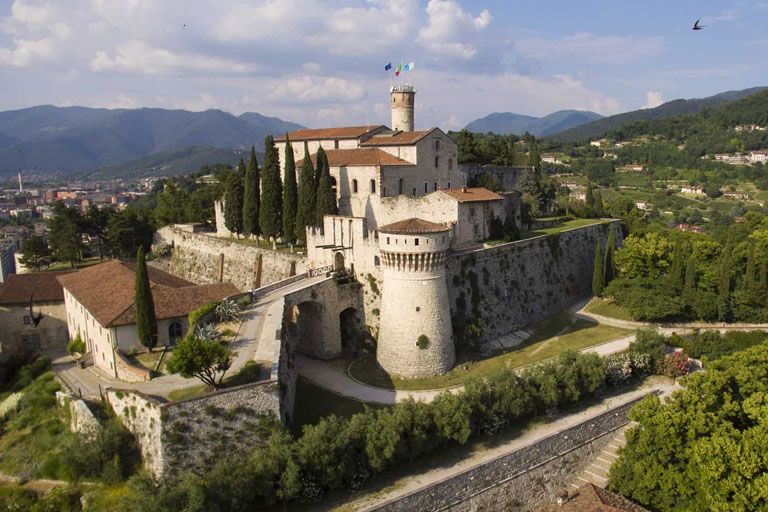
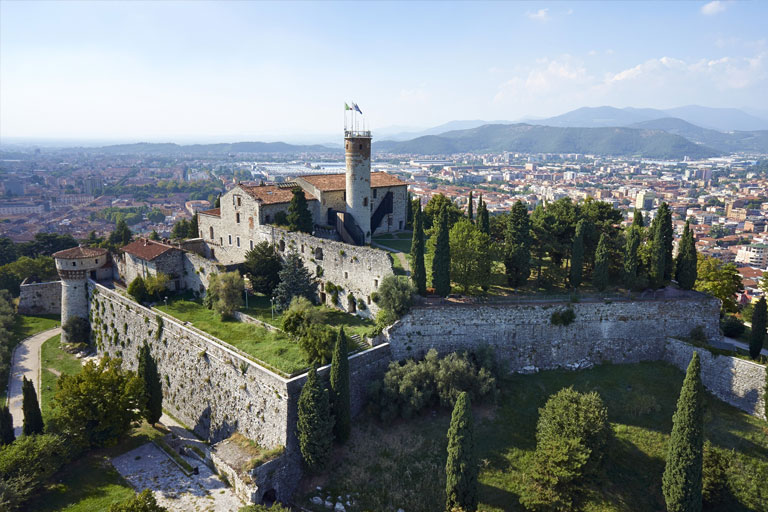
Rising above the city, the Castello di Brescia commands attention from its perch on Cidneo Hill. This fortress, one of Europe’s largest, tells the story of military architecture from Roman times through the Venetian period. Within its formidable walls, the Museum of Arms Luigi Marzoli houses one of Europe’s finest collections of historic weaponry, while the panoramic views from its ramparts offer a lesson in urban geography, showing how Brescia grew from its ancient core.
Sacred Spaces: The Two Cathedrals
The presence of two cathedrals in Piazza Paolo VI creates an architectural dialogue between different periods of Christian history. The Duomo Vecchio, known as La Rotonda, represents one of Italy’s few examples of a round Romanesque church, its cylindrical form suggesting connections to early Christian architecture. Besides it, the Duomo Nuovo rises in Baroque splendor, its massive dome a testament to 17th-century architectural ambition.
A Region of Riches
Brescia serves as gateway to some of Italy’s most captivating landscapes and epicurean delights. The nearby Franciacorta region has perfected the art of sparkling wine production, using traditional methods to create wines that rival champagne in complexity and refinement. Here, ancient monasteries have been transformed into wineries, and medieval villages overlook meticulously tended vineyards.
Lake Garda, Italy’s largest lake, offers a different kind of pleasure. Its microclimate, which allows olive trees and citrus groves to flourish at unusually northern latitudes, created the perfect conditions for elegant villas and gardens. The lake’s towns, from romantic Sirmione to bustling Desenzano, each preserve their unique character while sharing in the region’s rich history.
Living Traditions: Festivals and Cuisine
The spirit of Brescia comes alive during its festivals, none more famous than the Mille Miglia. This historic car race, described as “the most beautiful race in the world”, transforms the city into a living museum of automotive history each May. The sight of vintage cars passing through medieval streets creates a unique dialogue between past and present.
Brescia’s cuisine tells the story of its geography and history. Casoncelli alla Bresciana, with their complex filling of breadcrumbs, cheese, and meat, speak to a tradition of making the most of available ingredients. The Spiedo Bresciano, a feast of slow-roasted meats, recalls the hunting traditions of the nearby mountains. Each dish served in the city’s trattorias and restaurants contributes to a culinary heritage passed down through generations.
Why Brescia Captivates
More than a collection of monuments or a series of historical events, Brescia represents the continuity of Italian urban life across millennia. Here, ancient temples serve as museums, medieval churches host contemporary art exhibitions, and Renaissance palaces house modern offices. The city demonstrates how each generation builds upon the achievements of those who came before, creating a living museum where past and present engage in constant dialogue.
Whether you’re tracing the footsteps of Roman citizens in the ancient forum, sipping Franciacorta in a medieval piazza, or watching vintage cars race past Renaissance facades during the Mille Miglia, Brescia offers experiences that engage all the senses and connect visitors to three thousand years of human creativity and resilience.
This is the true essence of the Lioness of Italy – not just a city of monuments, but a living testament to the enduring spirit of human civilization, where each stone, each tradition, and each innovation adds another chapter to a story that continues to unfold. Come to Brescia not just to visit history, but to become part of its ongoing narrative.