ZRG Strikes Gold
•
Telenor Microfinance Bank awards ZRG OneView Contact Center System
•
ZRG Receives 5th Consecutive Achievement Gold Award from FPCCI
•
Al Baraka Bank Chooses ZRG OneView CMS Software
•
PSO Awards Contact Center Tender To ZRG
•
ZRG Strikes Gold
•
Telenor Microfinance Bank awards ZRG OneView Contact Center System
•
ZRG Receives 5th Consecutive Achievement Gold Award from FPCCI
•
Al Baraka Bank Chooses ZRG OneView CMS Software
•
PSO Awards Contact Center Tender To ZRG
•
ZRG Strikes Gold
•
Telenor Microfinance Bank awards ZRG OneView Contact Center System
•
ZRG Receives 5th Consecutive Achievement Gold Award from FPCCI
•
Al Baraka Bank Chooses ZRG OneView CMS Software
•
PSO Awards Contact Center Tender To ZRG
•
ZRG Strikes Gold
•
Telenor Microfinance Bank awards ZRG OneView Contact Center System
•
ZRG Receives 5th Consecutive Achievement Gold Award from FPCCI
•
Al Baraka Bank Chooses ZRG OneView CMS Software
•
PSO Awards Contact Center Tender To ZRG
•
Bologna’s three nicknames – La Dotta(The Learned), La Grassa(The Fat), and La Rossa(The Red) – each tell a fascinating story about the city’s character. The University of Bologna, founded in 1088, earned the city its first nickname by attracting scholars from across Europe and establishing itself as a beacon of learning. The second nickname celebrates Bologna’s rich culinary heritage, which has influenced Italian cuisine worldwide. The third nickname has dual significance: it refers not only to the stunning terracotta rooftops that create the city’s distinctive skyline but also to the city’s historical political leanings toward left-wing governance.
As the capital of Emilia-Romagna, Bologna stands at the crossroads of Italian culture. The region’s fertile Po Valley provides the outstanding ingredients that make Bologna’s cuisine legendary, while its strategic location between Florence and Venice has historically made it a center of commerce and cultural exchange. Today, this legacy continues as Bologna balances its rich traditions with modern innovation, particularly in its renowned food industry and academic institutions.
The Must-See Sites of Bologna
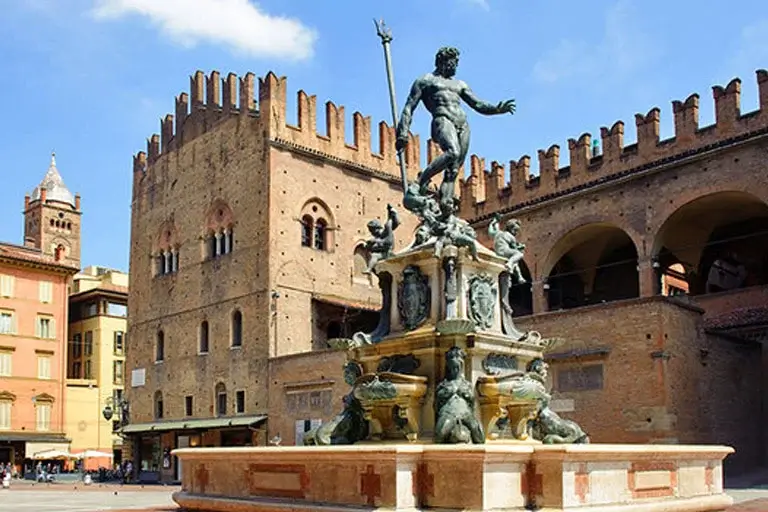
Piazza Maggiore and Piazza del Nettuno
These interconnected squares form Bologna’s civic heart, each telling a different story of the city’s history:
The Basilica di San Petronio merits special attention for its fascinating history. Construction began in 1390, but the façade remains intentionally unfinished – a reminder of a 14th-century political dispute with the Vatican. Inside, Cassini’s meridian line isn’t just a scientific instrument; it’s one of the world’s largest astronomical clocks, using sunlight through a small hole in the roof to track time and seasons with remarkable precision.
The Palazzo d’Accursio, beyond housing the Civic Art Collection, contains the Sala d’Ercole, where you can see stunning frescoes depicting the mythological hero Hercules. The building served as both a palace and a seat of government, demonstrating how civic and cultural life were intertwined in medieval Bologna.
The Two Towers (Le Due Torri)
While most visitors know about climbing the Torre degli Asinelli, few realize that Bologna once had over 100 such towers, earning it the nickname “Turrita”(the Towered). These towers served multiple purposes: they were status symbols for wealthy families, defensive structures, and fire watchtowers. The lean of the Garisenda Tower isn’t a structural flaw – it was built this way intentionally, showcasing the engineering prowess of medieval builders.
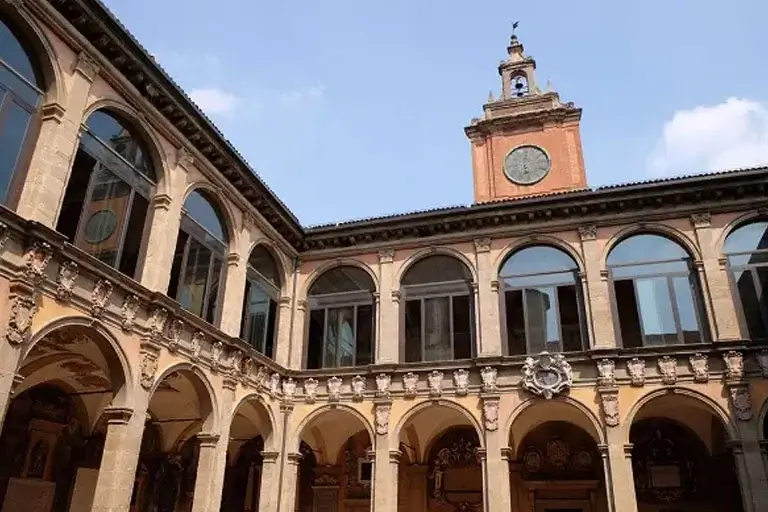
Archiginnasio of Bologna
The Teatro Anatomico deserves expanded explanation. This wooden anatomical theater was revolutionary for its time, featuring a marble dissection table illuminated by natural light through hidden windows. The carved wooden statues represent not just any doctors, but specific historical figures who contributed to medical science. Look for the two “skinned” figures supporting the teacher’s chair – they’re known as “spellati” and symbolize the importance of studying human anatomy.
Bologna’s Culinary Legacy: A Journey Through Time and Taste
The Historical Evolution of Bolognese Cuisine
Before diving into specific dishes, it’s essential to understand how Bologna’s culinary tradition evolved. The city’s location at the heart of the fertile Po Valley, combined with its historical wealth as a major medieval trade center, created perfect conditions for culinary innovation. The establishment of Europe’s first university brought scholars from across the continent, each contributing to the city’s gastronomic diversity. The powerful silk-merchant guilds of the Middle Ages helped establish Bologna’s reputation for luxury foods, particularly in pasta-making and charcuterie. The role of the “sfogline” (pasta makers, traditionally women) deserves special attention. These artisans have passed down their techniques through generations, maintaining standards so high that in 1972, the Chamber of Commerce officially registered the specifications for authentic Bolognese pasta. Each sfoglina uses a mattarello(rolling pin) that’s almost a meter long, requiring years of practice to master the technique of rolling pasta to the perfect thickness.
Iconic Dishes of Bologna: Understanding the Classics
Each classic Bolognese dish tells a story about the city’s history and values. Let’s explore these stories through the most renowned dishes:
Ragù alla Bolognese: The True Story
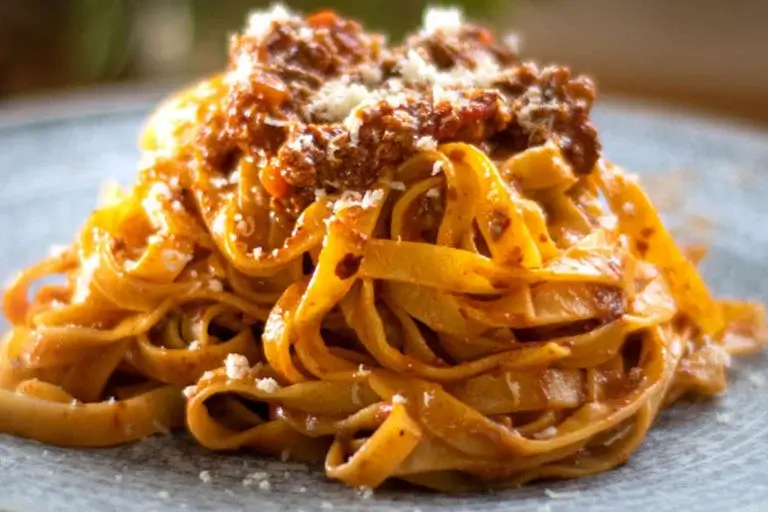
The authentic ragù alla Bolognese bears little resemblance to what the world knows as “spaghetti bolognese.” The official recipe, registered with the Accademia Italiana della Cucina in 1982, calls for a specific mixture of ground beef and pork, pancetta, carrots, celery, onions, tomato paste, white wine, and milk. The sauce simmers for at least 4 hours, allowing the flavors to meld perfectly. The milk, an ingredient that surprises many, serves to tenderize the meat and balance the acidity of the wine and tomatoes.
The Art of Tortellini
These small pasta rings aren’t just food; they’re a symbol of Bolognese craftsmanship. Each authentic tortellino must be exactly 2 grams and folded in a specific way that creates their distinctive navel shape. Local legend claims that an innkeeper in Castelfranco Emilia created them after being inspired by Venus’s navel, glimpsed through a keyhole. While charming, this story masks the more practical origin: the shape was likely developed to maximize the pasta’s ability to hold broth while maintaining structural integrity during cooking.
Mortadella: The Misunderstood Delicacy
Far from its American cousin “bologna,” authentic mortadella is a masterpiece of charcuterie. Its production was so important to Bologna that in 1661, Cardinal Farnese issued a decree detailing exactly how it should be made. Today’s mortadella must contain at least 15% high-quality pork fat cubes(the white spots visible in each slice) and be flavored with a specific mixture of spices including black pepper, coriander, and mace. The story of Bologna’s cuisine is inseparable from its history. When discussing tagliatelle al ragù, it’s important to understand why the authentic dish never uses spaghetti – the sauce was specifically designed to cling to the rough surface of fresh egg pasta, which wasn’t available in southern Italy where dried pasta was more common. The precise width of tagliatelle is even registered with the Chamber of Commerce: exactly 8 millimeters when cooked.
Traditional tortellini have a romantic legend behind their shape – they say a chef was inspired by Venus’s navel when creating these pasta parcels. The filling recipe is officially registered with the Italian Academy of Cuisine, containing a specific mixture of pork loin, prosciutto, mortadella, and Parmigiano-Reggiano.
Hidden Gems of Bologna
The Seven Secrets of Bologna
The “secrets” of Bologna deserve fuller explanation. The Whispering Walls in the Palazzo del Podestà work because of precisely calculated architectural acoustics – the vaulted ceilings create perfect parabolas that carry sound from corner to corner. This feature wasn’t just for entertainment; it allowed medieval merchants to have private conversations in public spaces.
The city’s hidden canals once rivaled Venice’s waterways, powering Bologna’s medieval textile industry through an ingenious system of water wheels. While most are now covered, you can still see glimpses of this network through various “windows” throughout the city, with the Finestrella di Via Piella offering the most picturesque view